
When It’s Time to Go. A Look at the Psychological Contract

Photo by Sora Shimazaki on Pexels.com

We’ve all grappled with the decision to leave an organization. By any measure, this is a difficult impasse to consider — often involving an agonizing “push” and “pull” of emotions. One day we might feel momentarily energized to “stick with it” for the long haul, only to have core issues re-surface in an amplified form.

Should we continue to hope for things to improve or cut our losses and begin the process of moving on? Previously we’ve discussed avoiding career regret and why we shouldn’t give up too quickly. However, there are some situations where we need to realize that enough — is well — enough.

One factor which is often a silent contributor to this decision, is the status of the psychological contract that exists between ourselves and our employer. Often the inevitability of leaving — has been cast long before the final decision to pull up roots has been made — as the very core of the employer-employee relationship has already been significantly damaged. The damage occurs when we have been let down in some way, or perceive that a promise has not been fulfilled. As such, it becomes increasingly difficult to remain committed, as we begin to lose focus and quietly disengage. In this regard, our physical departure only represents a ceremonial farewell. Truth be told, any investment in the employment relationship has already been halted.

The psychological contract that exists between employer and employee, plays a vital role throughout our work lives. Described in this research, the contract is “an individual’s belief regarding the terms and conditions of a reciprocal exchange agreement between that focal person and another party”. The health of this contract can affect the development of key workplace attitudes and behaviors (job satisfaction, trust, intention to turnover, etc.) While both parties contribute to the”give” and “take” of the dynamic — the contract is re-calibrated over the course of an employee’s tenure. Ultimately, when either party perceives a problem with balance, a breakdown can occur.

Let me offer an illustration. Recently I had a conversation with a highly competent marketing executive. Unfortunately, many obstacles had emerged in his current role, among these, the lack of a well-suited path for career growth and development. Over a period of time, he began to experience doubt that his employer had his best interests at heart. On the face of things he professed that he would remain committed — rock steady that he would continue to do his best to fulfill his role and make things work. But, in reality I observed that his psychological resources were waning as he was subtly disengaging. On a basic level, I believe he perceived that the psychological contract with his employer had been breached. (He did depart a short time later.)

Overall, the on-going viability of this contract is critical to our work lives. When problems arise, the strength and tenor of contract can become stressed. Ultimately, it is often difficult to acknowledge that the contract has been irreparably broken and admit that it may be time to explore new horizons.

What might be holding us back:

  • Attribution of failure. We may delay a departure because on some level we feel personally responsible for the current state. In our minds, the failure of the relationship equals a personal failure — which is often not the case. So, we remain to seek resolution.
  • Others seem happy. In some situations, the organization is just not the right environment for the specific employee, with a specific career need. Keep in mind that although opportunities might exist within your current organization, these opportunities may not be right for you.
  • Separation anxiety. Often we develop strong bonds with our colleagues, making a departure even that much more traumatic. We stay for them — when we should really be leaving for ourselves.
  • The “one more try” vice. If you have already done your best to bring core issues to the forefront without satisfactory resolution, it is difficult to find the energy to continue. You’ve likely done your part. Offer yourself permission to move on.

Often we have disengaged long before our physical departure from an organization or role. Have you ever experienced this? Tell us your story.

Dr. Marla Gottschalk is an Industrial/Organizational Psychologist and a charter member of the LinkedIn Influencer Program. She is the co-founder of Goba — a consulting practice that helps people & organizations build stronger work life foundation through core stability. Her thoughts on work & organizations have appeared in the Harvard Business Review, Forbes, BBC Work Life, Quartz and The Huffington Post

The Gift of Focus

alfonso-reyes-712273-unsplashI’ve been stuck on the word “focus” for the past couple of weeks.

Focus, or rather the lack of it — appears to be a growing problem in our work lives. At work, our attention has become infinitely divided; calls, e-mails, meetings, devices. We all need become acutely aware of the need for focus or I fear the quality of our work will slowly diminish.

The reasons to allow time for focus are many. However the core justification really rests deep within our brains.

While we possess the ability to switch between tasks, we simply do not have the ability to attend to all of them effectively. (Research at Stanford has shown that heavy multi-taskers have trouble mastering even the simplest of tasks.) So, I’d like to pose the question: How are you doing focus-wise? Are you taking control of the issue?

Here are a few practical suggestions to help you bring more focus into your work life. It all starts with one small step.

Strategies to consider:

  • Tame those e-mails. Seriously, e-mails are going to be the death of us — as they insidiously rob us of focus each and every day. (Do you feel like you are falling down the rabbit hole?) Forward thinking organizations are beginning to ban e-mails during designated time periods or specific days, to allow employees the opportunity to focus on their work. First rule to tame this problem, courtesy of LinkedIn CEO, Jeff Wiener — if you want fewer e-mails, send less of them!
  • Segment meetings. Many meetings lack direction and become the antithesis of focus. One method to solve this, is to use a targeted agenda to thoughtfully segment the time spent in the meeting. For example, if you plan to meet for 60 minutes, segment time to allow for no more than 2-3 topics. Devote 20 minutes to each — enough time to review information, discuss and gain some closure. Identify a “time-keeper” to keep things on track and record topics to be addressed later.
  • Control your calendar. Only you can take the steps to make your spent time count. Review your schedule for the past week and ask yourself the following question: What you can eliminate to make room to focus on the tasks that matter? Then offer that gift to yourself.
  • Look around you. If your work environment doesn’t allow time (or a bona fide quiet space) to really focus, start making waves, While offices are designed for efficiency, open floor plans can become an enemy of focus (How about a few well placed walls?) Discuss options with your manager to provide an appropriate space to collect your thoughts.
  • Set a routine that works for you. Be sure set the right scenario to allow for focus. Consider elements such as the time of day that you seem sharpest, and the physical elements most conducive for you to think deeply (Personally, I require music). Aim for a 30-minutes of focus each day, to start. Of course, remember to build in breaks, as this allows your thoughts to coalesce.

How do you build focus into your day? Share your strategies here.

Additional reading:

Tame the E-mail Beast, Entrepreneur.com
Make Time for the Work That Matters, Julian Birkinshaw and Jordan Cohen, Harvard Business Review
Control Your Workday, Gina Trapani, Geek to Live

How Not to Manage an Introvert

nordwood-themes-483520-unsplash
Nordwood Themes @Unsplash

Do you supervise individuals who would describe themselves as an introvert?

If the answer is yes, you may want to take a moment to examine how you manage them. In many cases, we hold misconceptions about introversion which can lead to ill-fated supervisory decisions. I’d like to help.

While many people confuse being introverted with shyness — introversion is in fact, about how an individual handles stimulation and processes information. Those on the introverted end of the introversion/extroversion continuum, require a different set of workplace conditions to excel, and we need to become sensitive to their needs.

Small changes in management and workplace elements, can transact into a more comfortable environment which is conducive to success.

A few things to rethink:

  • Putting them on the spot. It would be misguided to expect an opinion from an introvert at the “drop of the hat”. One hallmark of introversion is the need to sit with one’s thoughts and process information  — often far from the “madding crowd”. If  you offer an introvert a period of time to process, you’ll likely take full advantage of their skills.
  • Publicly recognizing them. Stop yourself. Really. Many introverts would rather jump off a cliff than have attention shifted in their direction without notice. If they are about to receive an award or accolade, let them know what you are planning ahead of time. They’ll appreciate the gesture and have time to prepare.
  • Teaming. It’s not that introverts are against teaming —  they would just rather contribute on their own terms. This means time to ruminate over issues on the table and offering a bit of a lull before they will jump into the conversation. To an introvert, teaming can become a bit of a workplace nightmare, in direct opposition to how they would normally approach their work.  So, be sure to offer opportunities for introverts to start the idea generation process before team meetings and allow points in the conversation where they can jump in. (Try pausing 8-seconds before moving to the next topic.)
  • The power of a quiet space. You don’t have to be an introvert to appreciate a calm environment in which to process information. Incorporating spaces within your office design that allow for both peace and privacy, is always wise. (Read more about that here.) Someone leaning toward the introverted side of the continuum, will be forever grateful.
  • They have nothing to communicate. By nature, introverts can be less likely to share their thoughts — which makes it even more important to check in with them regularly. Send them an e-mail, asking how their projects are progressing. They can reflect and respond on their own terms.
  • Introverts cannot lead. Truth be told — you are dead wrong here. Recent research has shown that those on the introverted side of the continuum are more open to a differences in opinion than their extroverted colleagues. As a result, they are more likely to make more informed decisions. In fact, it has been shown their hesitancy to monopolize the conversation, can actually make them powerful team members. Sounds like leadership material to me.

Are you an introvert? What workplace conditions help you excel?

Dr. Marla Gottschalk is a Workplace Psychologist. She also writes for Linkedin and formerly at US News & World Report.

5 of the Funniest Workplace Commercials of All Time

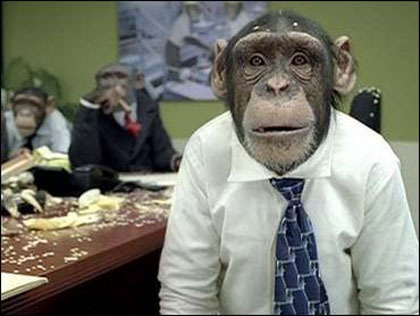
careerbuilder_chimpanzees_2006_1223

I’ll admit it — I watch the Super Bowl just for the great commercials. (Super Bowl ads should be considered an art form in their own right.)

Personally, I really appreciate a clever commercial. But, when you set a great ad in the context of work, the magic can really happen!  Somehow, other people poking fun at universal workplace issues (such as annoying co-workers and the ever-present issue of competition) — really allows us to take a break, laugh, and gain a new perspective.

So in deference to all of the great commercials out there — here are 5 of the all-time funniest commercials set in the workplace.

Which one is your favorite?

5. “Working with Monkeys: Business Trip” —  CareerBuilder
Ever wished for better co-workers? This poor guy sure does. (Check out the entire series.)

______

4. “I Don’t Have Any Friends Like That”  — IBM
You might think that that social media makes you a better employee. Well think again.

______

3. “Running with the Squirrels” — EDS
Never under-estimate your competition. Ever.

______

2. “Hump Day”  — Geico
Some of us don’t hate Wednesdays.

______

1. “Fast Talker” — FedEx
Is faster really better? Hmmmm.

_____

Please add your favorites in the comments section below. (I’ll be sure to draft a Part 2).

Dr. Marla Gottschalk is a Workplace Psychologist. She also writes for Linkedin and US News & World Report.

It’s Time to Deal with Procrastination

paul-hanaoka-SnBnFz9--y0-unsplash
Photo by Paul Hanaoka on Unsplash

Have you found yourself at war with an entry on your “to-do” list. Are you staring down a task, project or phone call that has been literally chasing you all week (all month for that matter)? Somehow we never fully escape that impending doom. With time it seems the task only looms larger.

Procrastination is a problem that we create for ourselves — and it’s high time we took back the reins.

But, first things first. Why do we continue to procrastinate?

We realize that putting off the task isn’t doing us any favors (and we know this). In most cases, it only delays the inevitable, while increasing anxiety. Yet without fail, we still seem hell-bent on putting things off. It makes no sense, yet perfect sense — all in the same breath. There is a pay-off lurking there and we have to stop the dysfunctional cycle.

Procrastination is indeed a common workplace challenge, and most of us struggle with it from time to time. But don’t fret, researchers estimate that only 20% of us are actually chronic procrastinators (this figure holds world-wide). The rest of us simply have moments when we struggle to take action. With guidance and some measure of awareness, we can usually move through the problem effectively. So let’s dig in.

Procrastination often develops when we have conflicting emotions concerning a task.  causing us to feel torn. An examination of approach – avoidance conflict may lend us a few useful clues. Early theories of motivation, including the work of Lewin, identified the notion that tasks/goals can possess both appealing elements (that will influence us to move toward them) — and unappealing elements, (which influence us to move away from them). It is this dichotomy that often befuddles us. Overall, when a task lies in the future, we feel more optimistic about moving toward it. However, as we move closer to the task or event, the negative aspects become much more salient. These forces influence the dynamic which follows.

It has also been suggested that goals can be characterized as either “approach goals” or “avoidance goals”. An approach goal would reflect a desired or positive outcome, such as studying to earn an “A” — and an avoidance goal would focus on staying clear of an outcome that is unfavorable, such as studying to avoid failing. (Think of all of those failed New Year’s resolutions — were they framed positively or negatively in your mind?) Research has shown that “avoidance goals” have a greater tendency to fall prey to procrastination. So, it seems that how we “frame” our view of a goal is critical.

Approach and avoidance goals can differ in regard to other relevant dimensions as well — and these factors also impact our behavior. For example, those who focus on approach goals are more likely to report feeling satisfied when they actually achieve such a goal. Moreover, personal meaning can also positively affect goal attainment.

Exploring why we feel negatively about a goal, may help us move toward it and possibly understand our tendency to procrastinate. So, let’s peel back the layers and examine the reasons behind our penchant to procrastinate and discuss methods to neutralize them.

First, a few reasons why we might feel negatively about a task:

  • The task is overwhelming. In many cases, we delay because the task just seems impossible to tackle. We really don’t know how to tame the “Goliath” — and as a result, we find ourselves completely frozen.
  • We’re fearful of failure. Unfortunately, failure is often the first thing that comes to our minds. So, we put off a task simply because we feel we are not likely to be successful. Why engage in a losing proposition?
  • We don’t want to commit. Sometimes we hold off because we are obsessing over which course of action to take. If we don’t choose — our options remain open.
  • The task is unpleasant. When a topic area really doesn’t interest us, laboring through it can turn into a long and painful process. On some level, avoiding the task becomes a fruitless form of protest.
  • The task seems pointless. If you have ever been stuck with a weekly report that few people read, you’ve likely experienced this. Sometimes we feel that the task isn’t worthy of the investment in our time.
  • Collateral damage. In some cases, we develop a negative association between the task and something or someone else. It’s not the task that you feel uncomfortable with, it is the individual who asked you to complete the task or what its completion signifies.
  • No rewards in sight. It’s difficult to stay motivated or focused, when the work you are about to complete will  go completely unrecognized. Why bother?

Potential solutions:

  • Set interim goals. Recent research suggests we should set smaller, approachable goals, to keep performance levels high. This involves identifying “bite sized” pieces that when attacked — add up to forward momentum and a successful conclusion.
  • Ask for help. If we feel seriously unprepared, the best route is to reach out and seek guidance. Often, another point of view from a mentor or supervisor can provide a much-needed “jumping off” point.
  • Collaborate. Drafting a friend or colleague to form a short-term “anti-procrastination” team, can prove to be an excellent approach. In these situations, two heads are usually better than one.
  • Narrow the choices. If you are having trouble weighing options use this handy sorting method: Put each option on a note card. Choose your top 3. Compare to find the winning plan.
  • Incentivize the process. One way powerful method to self-manage, is offering yourself a reward when you make progress. Try attacking your least favorite task of the day first —  then spring for your favorite latte. Offer yourself a “pat on the back”. Breaking the procrastination cycle, is no easy feat.

What techniques do you utilize to tame procrastination? Share them here.

Dr. Marla Gottschalk is a Workplace Psychologist. You can also find her on Twitter and Linkedin.

Music = Inspiration

Confidence2images

From time to time, we all experience our own form of “writers block”. The words (and work) stop flowing, as we find ourselves faced with that invisible, impervious “wall”. We might be working too hard or lingered too long solving a specific problem. Whatever the scenario — inspiration is absent.

As we know, changing gears completely can lead to a breakthrough (Read more about the Eureka Phenonmena here.) Listening to a great piece of music, can affect this gridlock — setting our minds in motion, in an entirely different direction.

Here are six pieces of music that might take you away from the pressure, and lead your mind toward a more productive, fluid space. I happen to find these selections helpful. However, I would love to know what you queue up when energy is running low. Share them with us here.

A little extra inspiration never hurt.

Bittersweet Symphony by The Verve:

______

What A Wonderful World by Louis Armstrong:

_______

Clocks by Coldplay:

_______

The Best is Yet to Come by Frank Sinatra:

______

Nessun Dorma by The 3 Tenors:

______

Sweet Disposition by The Temper Trap:

______

Dr. Marla Gottschalk is an Industrial/Organizational Psychologist. She also writes for Linkedin and US News & World Report.

Finding Career Chutzpah: Why We Don’t Ask for What We Need at Work

damiano-baschiera-763441-unsplash
Photo by Damiano Baschiera on Unsplash

It is difficult to ask for what we need career-wise.

But, that hesitation doesn’t make us less deserving. We all have something we need, whether it is guidance, a more flexible schedule, increased challenge or exposure.

But we are fearful. We hesitate. We role-play the potential outcome of the conversations in our minds.

To progress in today’s world of work, mastering “the ask” is an absolute necessity. Wherever you find yourself in your career journey — asking for what we need is simply a challenge we must overcome. If not we begin to “whither on the vine”.

How do we address this common problem? Rather than examining the “hows” of asking for what we need — let’s examine the “whys” behind our hesitation.

A few things that hold us back:

  • We’re in the dark about our performance. In some cases, we are simply unsure of our actual worth. Why? Because we don’t seek honest feedback. Asking your boss, clients or colleagues, “How did you feel about the work I completed?” is a fair and reasonable question. So — ask away. We need to know where we stand to feel we are in any position of power. Gathering the facts is really the only way.
  • A couple of “hard knocks”. In part, this is all a confidence game, and we have all experienced setbacks at work. Because of these experiences, we can develop a bit of a “blind spot” concerning our true value. We become guarded and hesitate to take risks. In the end, we have to look at failures as learning experiences — then commit to looking forward. Just remember, you are in good company.
  • We hate to brag. This is really tough one. Most of us feel we shouldn’t “toot our own horn” or play up our strengths. However, to secure that needed “leg up” — we need to ensure that others are noticing our work. A little well-placed “Marketing” is a necessity. Mention skills and accomplishments as “data points” that directly relate to the opportunities that are being discussed.
  • We don’t like to ask for anything. You may not like to depend on anyone to help secure your future. You may even think this would cause you to appear needy or less competent. Remember that no one is an island. It actually takes many people to build a meaningful career.  So open yourself up to reach out.
  • We’ve made unreasonable comparisons. Sometimes we feel unworthy because we are drawing unhealthy comparisons in relation to the careers of others (and judging ourselves harshly). We feel we don’t measure up and don’t have any claim to valuable outcomes. The imposter syndrome can also be at play — so be sure to face your doubts, as they are likely unreasonable.
  • We are afraid of the word “No”. The prospect of being rejected is never a pleasant — and hearing a negative response is a possibility. However, remember that we have the ability to recover.

This dynamic takes time to overcome. Simply start small and work your way forward. Asking for what you want or deserve might be difficult the first time around — but the process will get easier.

Just remember this: If you ask —  you just may get.

Have you been faced with this dilemma? What happened?

Dr. Marla Gottschalk is an Industrial/Organizational Psychologist. She is a charter member of the LinkedIn Influencer Program. Her thoughts on work life have appeared in various outlets including Talent Zoo, Forbes, Quartz and The Huffington Post.

Getting Over the Hump of “Hump Day”

camel

Wednesdays — the grumpy “middle child” of the work week.

If only Wednesday could magically turn into a Friday, or dare I say transform into Saturday.

While you might have breezed through Monday and Tuesday — somehow Wednesday just seems to “snag”. Our refreshed feeling from the weekend has definitely faded. You may find that you struggle through meetings and “zone out” while others are speaking.

If you aren’t having a particularly exciting week or already feel overwhelmed, you may wonder if you’ll get through to Friday.

I’ve actually held a grudge against Wednesdays for years — and I don’t think I’m alone. It’s really a bit unfair. So, it’s time to change our tune.

Wednesday’s don’t need to be the day that we just “get through”.

In this vein, here are a few strategies that might help make Wednesdays your favorite day of the work week:

  • Save the best for Wednesdays. Hoard something you enjoy work-wise for mid-week. For example, a project that really interests you. Even if the time increment is modest (say 20 minutes) — you’ll feel more energized.
  • Get out of the building. Anoint Wednesdays as the day you make plans to leave the office (and yes, your computer) for lunch. Invite someone new to join you each week — someone that has an interesting role or personality.
  • Start the day with a boost. Do you have a favorite colleague or business contact? Allow yourself time to reach out to them first thing on a Wednesday — a great way to boost both perspective and mood.
  • Laugh a little. Start out Wednesdays with a workplace humor. Read a few New Yorker cartoons or listen to a clip from your favorite workplace inspired movie. (I love clips from Office Space.)
  • Improve you. Make Wednesdays, the day of change. Disallow a workplace behavior that probably isn’t doing you any favors — and revise the “status quo”. For example, aim to go the entire day without contradicting someone. Listen without interrupting. Refrain from sending e-mails that could replaced by a walk down the hall. You get the idea.
  • Be nice. Show a little gratitude. Make Wednesdays the day that you thank as many people as possible for adding something positive to your work life. Bring your “stars” a coffee or a danish and vow to stop taking people for granted.
  • Build on a success. Review the events of last week and tease out at least one success. Write down 2 or 3 actions that would build on that progress — and keep the forward momentum going. Now follow through.

How do you get through “Hump Day”? Share your strategies.

Dr. Marla Gottschalk is an Industrial & Organizational Psychologist. She also writes at liveworkthinkplay.com.