The ”Catch 22” of Organizational Structure, Talent & Innovation

lycs-architecture-744230-unsplash

Photo by LYCS Architecture on Unsplash

At first glance, organizational structure may not appear to be an exciting concept.

Yet, an HBR post discussing how established organizations just can’t seem to keep pace with start-ups in the innovation arena — has caught my attention. It seems clear that the innovation dilemma has a fundamental relationship with the traditional elements of organizational structure, and how those elements develop and solidify over time. One key system which affects the potential to innovate: How organizations secure needed talent.

Structure and Maturation
As an organization matures, many systems within the traditional structure can become rigid. Communication channels become formalized, salary levels are set. On one hand, organizations become a safer and more secure place for employees. But, unwanted by-products such as inflexibility come along with this territory. Ultimately this affects how talent is sourced, limiting the ability of a maturing organization to effectively evolve and innovate.

Ideally, the talent equation begins with leadership and the work at hand, where leaders have the responsibility of translating vision into specific goals and tasks. These tasks in turn, require a set of needed talent elements for completion. Often, the necessity to forecast these talent requirements can become a looming challenge for hiring managers and the entire HR function, which supports that search.

The Catch
The simple truth is that mining talent through traditional channels can take too much time — where a mature organization may not be nimble enough to find needed talent quickly to meet the demands key challenges. But, the clock is ticking if they hope to remain competitive. It’s time vs. talent — and options which provide a more direct route to source and onboard needed talent are required.

Gaining the right perspective is a great place for an organization to begin. In a previous post, I discussed a prediction by Gartner concerning the application of work swarming within organizations. This is a concept which implies that the structure of an organization must flex to allow needed talent to gather quickly (and organically) to tackle projects. The process should allow not only talent from within the organization to gather, but from the broader external environment as well.

Breaking Down Walls
Extending the “virtual walls” of an organization can greatly expand the talent horizon. One interesting option is to leverage contacts within the  industry, or related industries who might possess relevant knowledge concerning a project or subject. One view which has been posed is to collaborate with suppliers to source talent and solve key problems.

Another method of sourcing talent would be to build or access a talent community, a method which capitalizes on the advantages of social media and employee networks when searching for needed skill sets. In this way, an organization develops an extended talent network which can be tapped as needed. Members of the community can be quite varied and can include potential contributors, such as freelancers or those working in related settings.

Another avenue would be to utilize crowdsourcing techniques to staff specific projects. In this way, organizations  bypass portions of the traditional HR hierarchy to enable them to address talent issues in real-time. When a problem or challenge exists, it is placed in an open forum, and staffed.  Of course, there are issues that the organization would have address to maximize this process, but the potential seems apparent. (Platforms such as InnoCentive, have been already been successful in facilitating specific open innovation challenges for mature organizations.)

Possible Snafus
The overall goal of applying these methods is for the organization to have the capability of retaining that innovative “edge”, long beyond the start-up phase. In a sense, slowing down the solidification of a counter productive elements which deter talent from reaching an organization in a timely manner. The process would have to be perfected. Here are few issues that come to mind:

  • What types of projects or challenges would be more appropriate for these solutions?
  • How do we effectively track KSA’s? (Knowledge, Skills and Abilities)
  • What specific legal steps must an organization take to make this happen?
  • Overall, how will HR help to guide the process?

The future of innovation within mature organizations is certainly dependent on finding needed talent. Hopefully, with collective thought we can improve opportunities for more established organizations to find that talent more readily, and retain their potential to innovate and excel.

Dr. Marla Gottschalk is a Workplace Psychologist. Contact her practice at marlagottschalk@comcast.net. You can also find her on Twitter and Linkedin.

Tell the Story of Your Organization

ryan-graybill-388794-unsplash
Photo by Ryan Graybill on Unsplash

Tell me a leadership story — one that embodies the very core of where you and your organization are headed. There may be spread sheets and profit margins. Metrics and shortfalls. But, stories paint an engaging  portrait of any organization or institution.

All businesses possess a rich history and leaders play a pivotal role in that developing story. Whether a start-up or established venture, leaders have a story to tell.

Leaders can provide a compass for change, can align vision with talent and have the power to exert a tremendous influence upon an organization (whether positive or negative). A leader can catapult an organization to the forefront of an industry or bring it to an early demise. Just as great presidents have helped shape our country — leaders help define an organization, for better or worse. Tell me a leadership story — especially those of the leaders that have failed. We can learn from that, as well.

Leaders that takes the helm of an organization at a given point in time, can reveal volumes about the state of that organization and where it might be headed. Each phase of an organization’s development required a very different type of leader — and that’s a lesson in itself. Tell me about that.

However, there is another story we need to hear.

Tell me your organizations leadership story.

We can all to this. So what is your story. What has been left untold?

Telling the tale of an organization’s leaders can serve as a powerful learning tool — one which can leave a lasting impression on an employee.

  • Onboard history. Speak of the leaders who were present in the early phases of the organization’s life cycle. Explain their vision and how it shaped the organization.
  • Failure 101. Reflect on leadership failures and what was learned in the process. How did these failures change the course of the organization?
  • Who is at he helm? Introduce current leaders and the expertise they bring to the organization. Explain how their current vision has been translated into strategy and action.
  • Strategy review. Discuss key inflection points that influenced the organization. How did leadership impact the outcomes? What did we learn, going forward?

With a look to the past,  we can improve the future  and possibly avoid costly mistakes that have already been made. Take the time to discuss the rich history of leadership in your place of business and offer your employees the advantage of perspective.

Tell the story of your organization. It’s a tale that needs to be told.


Dr. Marla Gottschalk is a Workplace Psychologist. You can find her on Twitter and Linkedin.

The Evolution of Work: Permalancers, Slashers & the Career Pivot

edited markus-spiske-773758-unsplash

Change is inevitable, and when a strained job market has to flex with the increasing pressure of a sluggish economy, something has got to give. Not necessarily to the betterment of organizations. Not necessarily to the advantage of employees. What occurs is simply Darwinian theory applied to work. Jobs evolve – and mutate.

The structure of work and its evolutionary past
Often the impetus for the change comes from the external environment, and over the course of time jobs have changed to meet the state of the world. From the inception of the role of apprentice to effectively transfer needed skills through the generations – to the needed presence of women in the workforce during World War II – the world of work has changed to adapt to the state of the world.

In our current economy, organizations can be fragile and funds are often tight – limiting the number of full-time employees that can be supported. In response, changes have occurred to the structure of work to deal with these imposed constraints. Whether these changes are transitory in nature, or here to stay remains unclear.

Trends to note & observe:

  • Permalancing – The notion of permalancers, those freelancers who spend long periods of time at an organization without actually being considered a full-time employee, raises all sorts of legal and ethical questions. Of particular concern is the obvious lack of job security and its eventual impact upon job satisfaction and performance. In a nutshell, these employees do not enjoy the same benefits or security as other employees within the organization. Some have viewed the positives of the arrangement, as flexible and realistic.  However, are these employees able to fully commit to organizational goals? Are freelancers distracted by their search for a permanent home?
  • Slashing – When full-time jobs are few in number, employees might have to take on more than one role to meet their financial obligations and fill a 40+ hour work week. Slashing, a type of career “multi-tasking”, has provided some workers the opportunity to pay the bills and stay afloat. Many may actually enjoy the variety of their roles – others may prefer a less dissociative career path. Sometimes, slashing can allow an individual to pursue an entrepreneurial dream, while still working at another role. But, how many of these individuals will choose to stick with this option when the economy stabilizes? What are the long-term ramifications for careers and pay?
  • Career Pivoting – Pivoting often entails a change in work setting or industry, where components of the current skill set are applied to a new role. These more “controlled” career path revisions seem to be occurring more and more often. Often the pivot emerges out of the need to follow the work, in other cases to pursue an improved career fit. How pivoting is actually accomplished will be a research focus, as vehicles such as mid-career internships become more popular. How many career changers are choosing a pivot instead of a more drastic career change? Are there opportunities for career pivoting within organizations? Will internships be available for those who require a mid-career revision?

The evolution of our world of work will continue in the coming years.  Learning how these changes impact employees and organizations is certainly the next step.

Dr. Marla Gottschalk is a Workplace Psychologist. You can find her on Twitter and Linkedin.

The Care and Feeding of Job Descriptions

Man Watering a Plant

One of the most interesting parts of my practice is observing how organizations grow and change. Growth often occurs in fits and spurts — and the accompanying pains can be quite distracting. I find that job descriptions almost never keep pace with that evolution. This creates a unique set of challenges as an organization moves forward. Frustration, exhaustion, and even anger are often expressed as roles, responsibilities and relationships within the organization are tested.

Job descriptions certainly aren’t “sexy” — however they remain a necessary facet of any business.

Often, older job descriptions simply don’t reflect the true nature of the work any longer. Roles can morph rather quickly and job descriptions can become increasingly inaccurate. If you have ever heard the excuse, “That’s not my job.” — this may exactly be the case. Confusion concerning task responsibilities can become a serious impediment as a business evolves. This is often insidious.

Sometimes the old job descriptions simply have to go.

In many cases, an entirely new set of tasks evolves and another role needs to be created. In this situation, it is likely the “skill gap” is being covered by other staffers and probably, not all that well.  You may need to act swiftly to dedicate an entirely new position to the tasks at hand. (Don’t get too caught up with the title, just cover the gap quickly.) Have you ever posed the question, “Is there work that needs to be completed regularly, but isn’t?”. This may be an indication that a new role is needed.

Job Descriptions Serve as HR Building Blocks
Job descriptions aren’t all that exciting — none the less, they serve to accurately document the work currently being completed. Moreover, these descriptions should serve as a key reference point for all of your HR functions, most importantly, selection and performance appraisal. Overall, job descriptions should keep pace with the changing landscape of your work.  How might you select an appropriate candidate for a role if the job description is an inaccurate representation of the work at hand?

Time for a review? Consider the following questions:

  • Have the number of employees in your organization increased dramatically over the past year?
  • Are you offering a new product or type of service?
  • Has the size of your customer base changed?
  • Does your organization have a new reporting obligation to a parent company?

A “yes” to any of these questions, could signal that the collective group of tasks in your organization has changed — and it is time for a review of your job descriptions, as well. Gather current descriptions and carefully consider them. Is there a current (and complete) job description for all roles? Are all task areas represented? Are the responsibilities listed, accurate? Be sure these questions are answered and revise your descriptions accordingly.

Growth and change can be frustrating at times. However, if descriptions keep pace, you can be assured a smoother journey. Sorting out “who does what”, and observing those tasks that naturally flow together to make up a role, may require some time. However, this exercise will greatly enhance how the work gets done.

Dr. Marla Gottschalk is an Industrial/Organizational Psychologist and business coach, located in East Lansing, Michigan. You can also find her on Twitter and Linkedin.

The Power of an Idea: Developing Your Own Idea Management System

cathryn-lavery-67852-unsplash(1)

I adore the movies — particularly films set in the workplace. I suppose this is an occupational hazard. (See a running list of the best of them here.) There is often a lesson to be learned from a great workplace inspired movie. But, there are a few which include classic themes about life and work. These are without a doubt, the movies we watch time and time again.

“Working Girl” is one of those movies. (See Siskel & Ebert’s 1988 original review here.) It has it all. Big business, big opportunities, romance — and the added interest of a really, really despicable boss. In this “David and Goliath” themed script, a secretary from Stanton Island (Tess, played by Melanie Griffeth), takes on the her silver-spooned, self-entitled boss (played flawlessly by Sigourney Weaver).

The plot centers on the ownership of a creative business proposal drafted by Tess, but peddled by Katherine as her own. There is an iconic elevator scene, where Katherine is finally put in her proverbial place after dishing out a hefty dose of lies and deceit. She is shut down so succinctly and so completely that you find yourself muttering, “Yes!”.

How the less powerful protagonist , shuts down her boss is worthy to note.

She did so with the power of inspiration.

It is the crucial moment where Tess explains how she happened upon her idea. The “Aha Moment” that ignited the notion that “Trask”  should move in an entirely different direction, toward radio instead of television — was the key to turning the tables on her boss.

“See”, Tess explains as she shows the clippings from the newspaper. “Trask…radio…Trask…radio.”

It’s one of the most satisfying moments for me in movie history — and it’s all about the power of a single remarkable idea.

Never underestimate the value of an idea
Some of the greatest moments in science and the arts come from a quick flash of thought. We’ll never be able to predict when those moments will occur. However being prepared to note them is critical. Few of us take the time to records and cultivate these moments.

Ultimately, it is up to you to effectively capture and nurture these moments.

What to do:

  • Respect your ideas. When you have an inspired idea don’t ignore it — listen and record it. Type a message into your phone or keep a notebook. Don’t let it slip away. Even DaVinci kept notebooks to keep his thoughts close to him.
  • Identify supporting materials. If you are reading a newspaper and find something useful or interesting, clip it. If you are on-line, bookmark the page.
  • Connect the dots. Once a week, review what you have collected and organize your thoughts into a concrete idea. Try writing each thought on a post-it note and sort them accordingly. Is there a pattern or common thread? Do they fit together somehow?
  • Evaluate. Review the idea the next day. If you feel the idea still has merit, do research and see what you come up with. “Deep Google” the topic to reveal nuances and applicability to your business. If you like what has developed, run the idea by a friend or colleague.
  • Develop the idea. Write a one-pager with details. Include your supporting sources and how the idea would be applied to your work.
  • Communicate. If the idea is still solid, map out a business plan or mini-proposal. Write a blog post. Draft a story. Develop a Slide Share deck to present it to others. Move forward somehow.

Vow to never waste another moment of inspiration. Value your ideas and give them the respect they deserve.

But keep the clippings — just in case.

Dr. Marla Gottschalk is a Workplace Psychologist. She also writes for Linkedin.

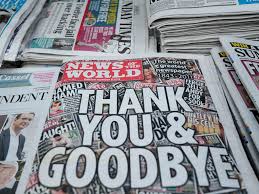
News of the World: When Organizational Culture Takes the Helm

News

It’s not often that a crystal clear lesson concerning corporate culture and organizational failure makes headlines worldwide. Certainly, we have come to understand how an organization can fail because of overall mismanagement, poor or untimely decisions or even the occasional leader mismatch. But it is a rare case when the sum of the parts, so to speak – the culture itself – has evolved into such a beast that it actually does the dirty work by itself. In the case of the UK’s News of the World, it seems that the terminally ill corporate culture was indeed the culprit.

Can a sick culture be cured?
In a sense the culture of New of the World was so vile, that even the surrounding environment closed ranks and acted – similar to that of a lone mutated cancer cell within the human body. This was a catastrophic failure of culture, not unlike an insidious mental illness left unchecked and untreated. Apparently the lack of regulation surrounding the British press was all the prodding required to bring about an organizational break with reality, decency and control.

The question remains as to whether this organization could have been cured. Mr. Murdoch (its owner) decided that this was not to be – for various reasons related to a much bigger picture. At the very least, we can surmise that the illness permeated to the quick of the organization and that transforming it into a healthy state was most likely impossible. For Mr. Murdoch, the damage to his reputation and his future business dealings, were being weighed in the balance. In a deluge of public disgust and disappearing advertisers, he pulled the plug on a 168 year old tabloid.

More than a leadership issue: When the culture takes over
Personally, I have always held the belief that the culture of the organization was determined by the people at the helm – and could be saved by the helm as well. When asked as a young psychologist as to the quickest way to ignite a needed organizational culture change, I responded that it was to replace those at the top of the organization. But in a situation such as this, it appears that in the end, the culture operating as a rogue offender did the deed on its own.

As time goes on, it is certain that more News of the World employees will be brought to justice for their role in the specific crimes committed against innocent individuals. But, in the case of the organizational culture gone bad, many of the associated crimes (disrupted careers, financial ramifications) will most likely remain unpunished.

Dr. Marla Gottschalk is a Workplace Psychologist. You can also find her on Twitter and Linkedin.

Too Big to Fail: Are We Enabling Organizations?


Office6

Corporate failure is a worthy topic to explore, as we can learn from the catastrophic mistakes of others.

HBO’s drama focusing on the events of the economic crisis, proves this point. The title — Too Big to Fail — of course refers to the nearly fatal infection of the financial services industry and the heroic measures taken to revive it. The film’s razor-sharp focus into the gut wrenching near collapse of an entire industry (and the eventual necessity of governmental intervention to avert demise), was an eye-opening look into the impact of organizational culture, its impact upon risk taking and failure.

Ripe for a Catastrophe
The movie attempts to probe the crux of the crisis — and offers a bit of explanation concerning the events which unfolded. It touches upon the inevitable contributions of sub-prime mortgages, credit default swaps and unchecked greed.

We now know that the problems of the financial sector cascaded into other industries, including the automotive sector — another industry woefully vulnerable to the unfolding economic downturn. While the financial industry seemed vulnerable to issues concerning risk, chronic problems within auto also begun to resurface. Issues such as quality and unrelenting competition from the Japanese. Eventually, American auto also required their own set of life-sustaining measures to continue.

Historically, this was not the first time that governmental support had been necessary to save an organization within the auto sector — or in other industries for that matter. Think Chrysler in 1980 or Lockheed in 1971. (Interestingly, the financial outcomes of these interventions for government, are not as poor as you might expect.) Why specific industries such as banking and auto, have required help repeatedly, may point to chronic cultural issues left unaddressed.

Have Lessons Been Learned?
After all was said and done, HBO’s effort was fascinating (I was riveted by Paul Giamatti’s portrayal of Ben Bernancke). However, a large part of the explanation seemed absent from the story. The movie did not delve into the cultural factors festering within these organizations — that undoubtedly provided the spark to ignite the entire tangled mess into a raging firestorm. Problems which lingered long before the crisis began — such as ineffective leadership, a culture of silence and the absence of longer-term strategic planning.

Which leads us into the heart of the dilemma. If these critical organizational problems are not been properly addressed within the organizations aided, have we essentially enabled them to make the same mistakes once again? After all, hadn’t both General Motors and Chrysler been down a similar path previously? What guarantees will we put in place to protect organizational health, 5 or 10 years from now?

It seems obvious that certain cultural issues have to be solved to ensure long-term organizational health. Here are a few topics to consider:

  • Teach leaders about the past. There seems to be a lack of a “collective unconscious” when the gavel of leadership is passed on within organizations. It seems that the completion of “Organizational History 101” should be required for all future leaders, in an attempt to avoid the re-occurrence of old problems.
  • Avoid “The Emperor’s New Clothes” scenario. A system of checks and balances should be in place when to ensure high quality decisions. Who will allowed to review or challenge the decisions of upper management? (Obviously a devil’s advocate was absent when auto execs took private jets to Washington seeking financial assistance.) Ask the question: Have we looked at all sides of this issue?
  • Don’t stop thinking about tomorrow. Don’t get stuck in the moment – even if things are looking up. Thinking that a favorable environment (whether financial or product-based) will go on forever, will likely catch us off-guard and unprepared. Run through various “what if” scenarios to plan for the inevitable upward and downward turns in sales. Setting strategy for these challenges in the future is key.
  • Avoid making decisions solely from a ledger sheet perspective. Risky short-term financial gains may lead to long-term calamities. If making money just seems too easy, ensure an evaluation of the accompanying risks that may later affect your organization. How will the move affect exposure to other financial or customer-related challenges down the line? Will emphasis in one area leave you open to weakness in another?
  • Utilize innovation to stay ahead of the game. Establish metrics to monitor and encourage real innovation within your organization, and communicate progress regularly. Whether you track patents or customer service successes — innovation can serve as an insurance policy for your company, offering new direction and opportunity.

Moving forward will likely reveal a challenging road. Let’s hope that key lessons have been learned.

Dr. Marla Gottschalk is a Workplace Psychologist practicing in East Lansing, Michigan. Follow her on Twitter.

Career Interrupted: Another Note to Millenials About Surviving the Job Market

MP910220976

It’s been a couple of years since my last note concerning the economic downturn, and unfortunately the job market remains a challenge for younger employees. We are all wondering when the job market will snap back to its old self – but it’s just not happening. It seems that some form of evolution in the workplace environment has already taken place. As a result, adapting to meet these changes is the best way to proceed. Tackle this head on.

Life at work has changed

“Mutations” to jobs – such as permalancing have occurred –  and these changes are emerging as the new “normal” for many across the country. These job mutations can bring along a whole new set of issues, such as “free-floating ” job insecurity and its eventual impact upon job satisfaction. It seems the old issues are still there – such as just trying to get established – along with these new issues to round out the list.

Still looking for meaningful work? Not meeting your key career goals? The bottom line is that you have to be willing to do what it takes to succeed. It’s tough out there, and you’ll have to be tougher.

Stay razor focused

If you are looking for work and your dream job is not on the horizon, attempt to find a role that is related to your target. Look for jobs that develop a skill that you will need down the line in your target job. (Check job boards for your dream job and note the job qualifications that are discussed – work on developing one or more of those skill sets). If you have reached the interview stage, do “strategic” research. Be armed with information concerning your match to the role, including what is unique about you and how you can help to accomplish organizational initiatives.

If you are currently employed, make your commitment to the organization known. This remains crucially important as senior employees will have an edge if things get tight staff-wise. If you are viewed as someone who is a part of the organization only until your “real work life” begins, you could be considered a possible cut, even if you are a high potential employee. The awful thing about this – the decision will be made without guilt, because they think you really want to move on.

Be ready to justify why you are needed. As we discussed, you may still have to sing for your supper – and that’s OK . Everyone has to at one time or another in their career. Really take a hard look every now and then at your contribution as compared to your colleagues. Don’t throw everyone else under the bus, but be ready to defend your right to work and your real value.

Strategies to remain competitive

  • Focus on the bottom line. Whether you wish to join a specific organization or are currently working, keep your eyes open for ideas which can improve areas such as operations and customer service. Sometimes a very small idea can lead to a big payoff.
  • Embrace intrapreneurship. You may not have the flexibility to find a new job – but it is possible to still branch out. If you have an idea for a product or service which could complement the current work within your organization, explore the idea with your supervisors. You can read more about that topic here.
  • Develop project management skills. Most employees who land jobs (and advance) within an organization require skills in this area. Knowing how to manage resources, meet deadlines and monitor metrics are key career skills.
  • Continue to volunteer for tough, unpopular, or even boring assignments. Showing that you don’t mind putting forth some extra effort may help you stand out in a decision maker’s mind if more staffing cuts do occur. If it is an assignment that elicits groans and rolling eyes at the staff meeting, you have found pay dirt.
  • Work on your own career “brand”. Know who you are as a contributor and promote this – especially if you are still looking for work. Ask yourself: “What do I stand for career wise?” This process well help define your future career path and what you have to offer an organization. Find that niche and  work that angle.

This job market requires flexibility and clear view of who you are as a contributor – keep your goals in focus and try to be positive, but remain realistic.

Dr. Marla Gottschalk is a Workplace Psychologist and Career Coach. Connect with her on Twitter and Linkedin.

What We Really Need Now From Theories of Leadership

Relaxed Businessman

I still hear discussions of Steve Jobs and his amazing contribution to the success of Apple. Although inspiring, it confirms my suspicions that we haven’t yet captured all we need to know about effective leadership. Strong leaders such as Jobs are often an enigma — and unraveling the source of their strength is critical as we move forward. His skills possessed some of the nuances and often non-quantifiable elements of leadership that we strive to capture.

However, these legendary tales don’t seem to help us develop emerging leaders.

Current theory (and accompanying practices) may not be enough for those interested in organizational success, to make confident predictions about required leader skills. This lack of confidence directly impacts the “state of the opinion” surrounding the selection and development of leaders.

This gap essentially affects all of us going forward.

A Debate for the Decades
Leadership is one of the most well researched workplace topics  and with good reason. Relevant theories of leadership have the potential to have limitless impact upon organizations and their employees. There is a great body of existing theory and research, beginning with the “great man” and trait theories.

However, are leadership theories capturing what organizations require to move forward effectively? The answer may be “no”.

Here is what we might need to examine, to move forward effectively:

  • A dynamic view of leadership. There has been a long-standing emphasis on the specific, individual attributes of leaders. (The list is endless.) But that may be distracting us from a larger, more dynamic view of leadership effectiveness. We may need to step back to take a much broader view that examines a leader’s overall ability to flex in response to the varying situations and stresses they may encounter. Organizational needs change rapidly which requires a leader to flex or change their approach as well. For example, we might  refocus on the notion of a leader’s potential to develop the right “script” for a specific leadership challenge.
  • Leader-culture match. Identifying an merging leader through succession planning or hiring an industry star is one thing. Being sure the leader can navigate the organization and gain acceptance is another. Does the prospective leader have the capacity to absorb the prevailing organizational mindset and represent that group? (Think of the debacle at Time, Inc.)  Culture of the organization is no longer on the fringes. It is a critical element to consider. If a potential leader cannot represent that culture and embody its vision — it is unwise to move forward, as context does matter.
  • Training  & development opportunities. By and large, if a theory doesn’t contribute to leadership development efforts, it seems relegated to a “read only or great to know” status. Descriptive theories are necessary, but more of a focus on usable training points is needed. Moreover, these experiences should not exclusively take place in a classroom setting. For example, does exposure to extremely challenging assignments and situations (as Jobs was) enhance a potential leader’s skill set moving forward? I suspect the answer is “yes”.
  • An integrative approach. Obviously, leaders do not lead within a vacuum. An approach that considers not only the leader, but followers, customers and external conditions is needed. As discussed in the American Psychologist (Avolio, 2007), integrating these elements is the future of leadership theory.

As organizations strive to innovate and remain competitive, effective theories of leadership will remain a focus. Hopefully, theories will continue to evolve and capture the synergy of elements contributing to leader success.

Dr. Marla Gottschalk is a Workplace Psychologist. You can find her on Twitter and Linkedin.

Want to grow your small business or start-up? Live larger.

annie-spratt-294450-unsplashMoving from a large metropolitan area to a small college town was quite a shock to my system. I recall driving home from the supermarket at 10:00 pm, noticing that the traffic lights were set to “flash only” status. At that moment, I realized that my life would change – and most likely be dialed down more than just a notch.

It was good thing and a bad thing at the same time. But, as a consultant, it gave me a unique chance to experience a whole new world of clients – those who owned smaller businesses.

Small businesses are unique
I learned very quickly that the DNA of a small business (or start-up) was quite different from the larger organizations that I had spent time with in the past. The problems appeared more critical, felt closer to the quick, and often a dream or family investment was entangled in the effort.

Over time, I saw a number of issues that would threaten the continued success of a small business as growth occurred. I also noticed a pattern that when growth did occur – certain business practices that worked well before just didn’t suffice any longer. Often the structure of the organization hadn’t grown, or evolved, to support changing demands.

Plan for tomorrow
In general, the owners needed to dial things up a notch and think like they were a much larger organization – changing with the demands of their new reality.

Here are a few trends that I have observed:

  • Informal communication channels begin to break down –  Of course, businesses rely upon these networks to communicate information about work procedures, customer practices and organizational mores such as a dress code. However, the informal system becomes strained as the number of people in the business increases. At this point structure must be implemented to ensure that messages are received consistently. This might include documenting formal job descriptions, an employee handbook and/or specific employee on-boarding procedures.
  • A review of computer software becomes necessary – As small organizations grow – often in fits and spurts – software is often purchased to rectify problems piece by piece. However, the overall user & system demands are not reviewed. At some point, it all becomes a tangled mess.  Be sure to review software every year to document what is not working and to flesh out future needs.
  • An adequate system to document your customer base becomes critical –  Although this sounds simple, I am  amazed when a small business really doesn’t have instant access to their top 25 customers. If a system to do so isn’t in place to do so – trouble will likely follow. Retaining customer loyalty begins with a solid base of information concerning who your customer is – their needs and concerns.
  • An idea management program becomes important – Even though your business may be smaller, there will be no shortage of ideas to improve the business from your employees – so be prepared. Unfortunately, not all of them will be feasible. So, a formal system to evaluate the ideas becomes necessary. Often employees are not aware of the risks or the potential organizational impact that comes with a change. Posing the idea in an open forum, with one of the business leaders present can be very helpful.

Don’t ignore the basic structure of your organization as growth occurs. Update important systems to meet the demands of your new business reality.

Dr. Marla Gottschalk is a nationally quoted Workplace Psychologist. She helps small businesses grow and become more effective. Find her on Twitter and Linkedin.